
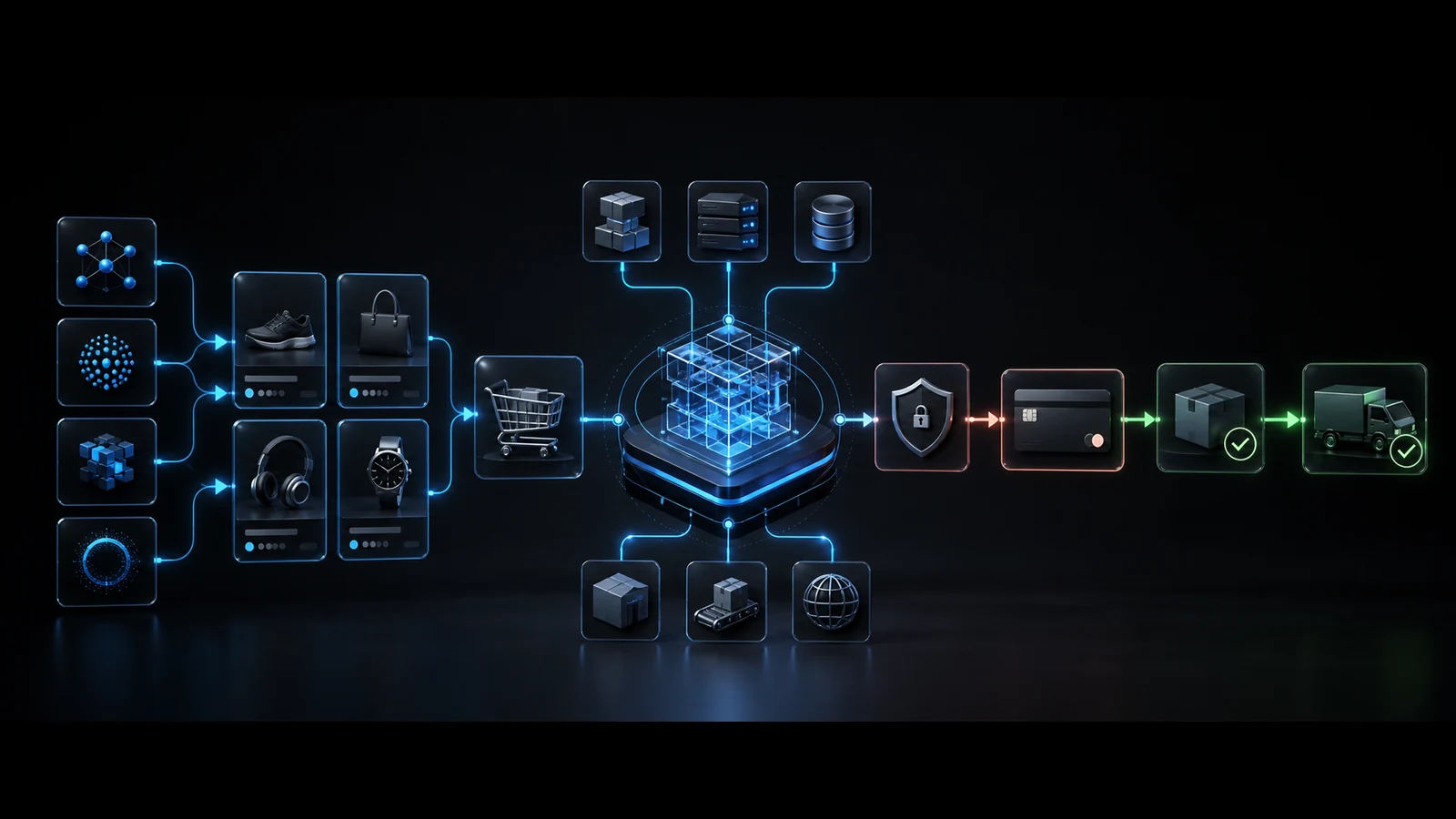
The basic model of online shopping remained stable for years: a person searched, opened product pages, compared options, added an item to a cart and completed a payment form. In 2026, a new actor is entering that journey: AI agents that can research, compare products and initiate approved actions on a user's behalf.
Agentic commerce is not merely AI recommending a product. It allows an agent to understand product data, verify availability and delivery options, create a cart and coordinate a secure checkout session. UCP is the open protocol designed to let agents and merchants communicate through a common language.
In January 2026, Google announced the Universal Commerce Protocol (UCP), co-developed with companies including Shopify, Etsy, Wayfair, Target and Walmart. In June, Shopify said its UCP and Catalog API developer infrastructure had become self-service. These releases are turning AI shopping from a demonstration into a real integration and operations challenge.
What is agentic commerce?
Agentic commerce is a model in which an AI agent understands a buyer's goal and coordinates multiple stages of the purchasing journey. If someone asks for “a quiet office printer under a fixed budget that can arrive in two days,” an agent can do more than return links:
- Translate the request into budget, feature, delivery and use-case constraints.
- Search structured catalogs for suitable products.
- Verify variants, inventory, price and delivery information.
- Compare alternatives and explain the trade-offs.
- Create a cart and checkout session after the user's selection.
- Bring the user into the flow for required authorization or approval.
- Track order, delivery and return events after purchase.
The critical difference is capacity to act, not the presence of a chat box. A conventional chatbot redirects the shopper to a product page. An agent can invoke operations that the merchant exposes through APIs and standard protocols.
What is UCP?
The Universal Commerce Protocol is an open standard that creates a shared commerce language for AI agents, applications, businesses, credential providers and payment service providers. Its purpose is to reduce the need for a separate bespoke integration between every merchant and every AI platform.
The official UCP specification and source are developed in the open under the Apache 2.0 license. The protocol expresses capabilities such as catalog discovery, cart, checkout, discounts, fulfillment, orders, identity linking and payment-token exchange in a machine-readable form.
The four core participants
- Platform or agent: the AI application that discovers products and invokes a merchant's supported capabilities for the user.
- Business: the entity exposing catalog, pricing, checkout and order capabilities while normally remaining the merchant of record.
- Credential provider: a trusted provider that stores sensitive information such as payment instruments, addresses or identity data.
- Payment service provider: the infrastructure responsible for authorization, processing and settlement.
How does UCP work technically?
A UCP-enabled business publishes a machine-readable profile at /.well-known/ucp. The profile declares supported services, protocol versions, payment handlers and capabilities. An agent presents its own profile, and the server selects the compatible intersection between the two parties.
- Discovery: the agent retrieves the business's UCP profile.
- Capability negotiation: both sides establish support for catalog, cart, checkout, fulfillment or order functions.
- Product data: the agent obtains current product, variant, price and availability information.
- Checkout session: a stateful checkout is created on the merchant's system.
- Identity and permission: OAuth, user approval and payment authorization are completed where required.
- Order processing: the business processes the order in its own system and retains the seller relationship.
- Lifecycle events: shipping, delivery, cancellation and returns are communicated through webhooks or related services.
UCP is not tied to one transport. Its documentation supports REST, MCP, A2A and embedded bindings. Existing commerce APIs do not need to be discarded; they can be made discoverable through a consistent capability and negotiation layer.
Traditional ecommerce vs. agentic commerce
| Area | Traditional Ecommerce | Agentic Commerce |
|---|---|---|
| Discovery | Search, categories and ads | Natural-language goals and context |
| Comparison | The buyer moves between tabs | An agent gathers options against constraints |
| Data consumer | Primarily people and search engines | People, search engines and action-taking agents |
| Checkout | Web or mobile form | Standard checkout session and trusted approval UI |
| Integration | Custom work for each platform | Common capability and protocol layer |
| Measurement | Sessions, clicks and conversions | Agent source, recommendation, capability calls and orders |
The real business shift: a website is no longer only a screen
A well-designed product page remains important because brand trust, explanation and legal information still require a human experience. But a store also needs a transaction surface that machines can use reliably.
1. Product data must be complete and current
A title and price are not enough. Variants, dimensions, materials, compatibility, inventory, delivery estimates, return terms and unique product identifiers need consistent definitions. If structured data conflicts with checkout data, an agent can recommend the wrong item or fail during the transaction.
2. Price and inventory need real-time validation
A difference between the AI answer and checkout price damages trust. Measure update delays across systems of record, caches, feeds and APIs. Promotion, tax and availability rules must always be verified on the server.
3. Checkout should be API-first
Cart, address, delivery, discounts, tax, payment and completion cannot depend exclusively on browser buttons. Each operation should be authenticated, idempotent, observable and recoverable when an error occurs.
4. The brand's approved answers need structure
Google's Business Agent direction aims to let shoppers speak with brands inside Search. Alongside product data, merchants need an approved knowledge base for warranties, service, returns, delivery and common questions. The agent must preserve trust after discovery as well as before the sale.
How should Shopify, WooCommerce and custom stacks prepare?
Shopify merchants
Shopify is developing Agentic Storefronts, Catalog API and UCP tooling inside its ecosystem. Merchants should review enabled AI channels, product-data quality, supported checkout paths and fulfillment coverage. Features and geographic availability may differ, so eligibility should be confirmed in current Shopify and channel documentation.
WooCommerce and packaged platforms
Prioritize product data, order APIs, webhook reliability and payment-plugin health. If a third-party UCP extension is considered, review version compatibility, key management, webhook signatures, support ownership and source-code security before granting production payment access.
Custom commerce systems
A UCP profile and capabilities can be implemented as an adapter in front of existing catalog, pricing, inventory, customer and order services. Core commerce rules remain in one place while REST, MCP and other agent channels gain controlled access. The off-the-shelf versus custom software guide provides a useful framework for this architecture decision.
Payments and security: agents do not receive unlimited authority
Under the standard UCP checkout flow, completion occurs manually through a trusted user interface unless an extension such as AP2 Mandates supports a more autonomous authorization model. The official UCP checkout specification explains how payment handlers are discovered and how token-based providers can keep raw card details away from the platform.
- Use a unique identity for every agent and integration.
- Grant only the catalog, cart or order permissions required for the task.
- Revalidate price, discounts and inventory on the server.
- Use idempotency keys and replay protection for checkout operations.
- Show explicit user approval and an immutable order summary before payment.
- Maintain auditable logs for agent request, user, price change and outcome.
- Provide human escalation for errors, support, cancellation and returns.
What does this mean for businesses outside the United States?
As of August 14, 2026, Google's direct AI Mode checkout announcements mainly concern eligible U.S. retailers and selected payment flows. Businesses should not assume that every market can immediately enable in-Google checkout. Preparation is still valuable because better product data, APIs and measurement also improve marketplace integrations, mobile apps, on-site search and conventional conversion.
Cross-border sellers need machine-readable rules for currency, tax, customs, delivery estimates, consent and returns. UCP standardizes technical communication; it does not remove the merchant's legal or contractual obligations.
A 90-day agentic commerce readiness plan
Days 1-30: data and process audit
- Audit fields and variants for the 100 highest-revenue products.
- Compare feed, schema, product-page and checkout prices.
- Map inventory, fulfillment, promotions, returns and support systems.
- Design source attribution for AI and marketplace transactions.
Days 31-60: agent-ready service layer
- Standardize catalog search, product lookup, cart and order-status APIs.
- Define authorization scopes, user approval, logging and error handling.
- Create a sample UCP profile and checkout flow in a test environment.
- Test stale inventory, price mismatch, duplicate request and failed payment cases.
Days 61-90: controlled pilot and measurement
- Select a limited product group and a lower-risk channel.
- Measure recommendation-to-cart, cart-to-checkout and payment completion.
- Review incorrect product matches and human handoff points.
- Expand products, markets and channels only after pilot evidence is strong.
Which metrics matter?
- Product impressions and qualified match rate in AI channels
- Recommendation-to-cart conversion
- Checkout completion and abandonment
- Failed transactions caused by price or inventory mismatch
- Agent-attributed revenue, average order value and new-customer rate
- Returns, cancellations, support contacts and human handoffs
“How many AI visits did we receive?” is no longer enough. In some flows, a shopper may begin checkout without opening a conventional product page. Measurement must capture authorized actions and revenue events, not clicks alone.
Frequently asked questions
Is Shopify required to use UCP?
No. UCP is an open standard that custom systems can implement. Shopify is a co-developer and offers one of the broadest ready-made ecosystems, but the protocol is not proprietary to Shopify.
Does UCP replace the ecommerce website?
No. The website remains essential for brand experience, trust, content, support and human-led purchasing. UCP adds a standardized transaction layer that agents can use alongside it.
Is Product schema enough for UCP?
No. Product and Offer schema help describe an item. UCP covers stateful cart, checkout, order, payment and authorization operations. They are complementary.
Should businesses invest before every channel is available?
Start with data quality, APIs, payment security and measurement. Even where UCP channel availability is limited, that foundation directly benefits marketplaces, mobile apps, B2B portals and the existing store.
Conclusion: become actionable, not merely discoverable
AI search visibility helps a brand appear in the right answer. Agentic commerce asks the next question: when an agent discovers your product, can it verify the offer, create a secure cart and move the customer into the correct checkout flow?
WebWizz brings product-data architecture, custom commerce services, API integrations, AI agents, payment flows and measurement into one roadmap. Start an agentic commerce readiness project to audit the data, integrations and controls behind your current store.