

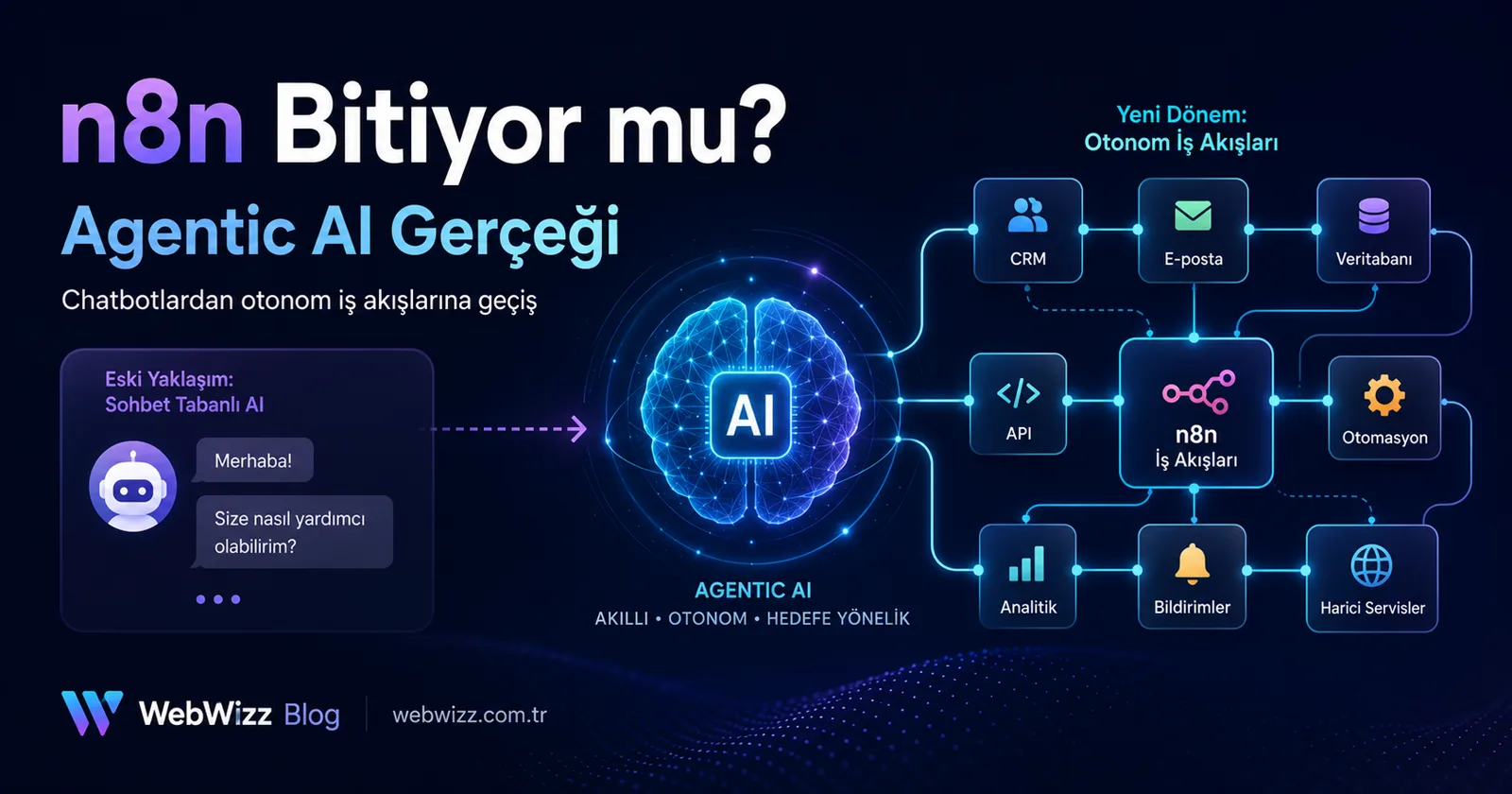
The world of artificial intelligence has moved from simple text-generating systems toward digital workers that can manage real business processes in only a few years.
In the early days of tools like ChatGPT, businesses usually expected AI to write a text, answer a question, or summarize a specific piece of content. Today, they expect AI systems to research prospects, update CRM records, prepare emails, analyze data, and complete a process by using different tools when needed.
This new period is called Agentic AI: artificial intelligence systems that can act with a degree of autonomy.
But this shift raises an important question:
If AI agents can manage business processes on their own, will automation platforms like n8n become unnecessary?
The short answer is clear: n8n is not ending. But the way it is used is changing significantly.
What is Agentic AI?
Agentic AI refers to AI systems that do not only respond to a command, but can plan their own steps to reach a defined goal.
An Agentic AI system usually has the ability to:
- Analyze a goal.
- Break the work into smaller steps.
- Decide which tool to use.
- Communicate with APIs, databases, or external applications.
- Evaluate the results of previous steps.
- Try a different method when an error occurs.
- Request human approval when necessary.
- Keep working until the process is completed.
Traditional chatbots mostly generate answers to questions. AI agents move toward a defined goal.
For example, if you ask a chatbot:
Find potential restaurant customers in Istanbul.
it may suggest research methods or list a few example businesses.
An AI agent, on the other hand, can use Google Maps or other data sources, list businesses, analyze their websites, extract contact information, save records into a CRM, and prepare a personalized outreach message for each business.
The difference is not simply better answers. The real difference is that AI starts to perform actions.
Is the chatbot era really ending?
Chatbots will not disappear completely. However, chatbots that only generate text will provide less competitive advantage for businesses over time.
A customer support chatbot that only answers questions is no longer enough. New generation systems are expected to understand the customer's request, check order status, determine the right solution, and create a task for the relevant department when needed.
The same shift is happening in other areas:
- Sales chatbots are turning into sales agents that analyze potential customers.
- Support bots are turning into service agents that solve problems and perform actions.
- Content tools are turning into agents that plan, draft, submit for approval, and publish content.
- Reporting tools are turning into analysis agents that interpret data and suggest actions.
- Coding assistants are turning into software agents that edit files, run tests, and fix bugs.
Gartner lists multi-agent systems among the strategic technology trends for 2026. In these systems, a large task is not given to a single AI. Instead, research, review, analysis, and execution can be distributed across different specialized agents.
In other words, the future may not be one super bot trying to do everything. It may be a team of digital specialists working together.
What is n8n and why is it so popular today?
n8n is a visual workflow automation platform that connects applications, APIs, databases, and services.
In an n8n automation, the process usually consists of predefined steps:
- New data arrives.
- Certain conditions are checked.
- Requests are sent to the necessary applications.
- Data is transformed.
- The result is saved into another system.
- A notification or report is created.
For example, when a contact form is submitted, n8n can:
- Receive the form data.
- Create a new lead in the CRM.
- Notify the sales team.
- Send an automatic email to the customer.
- Add a record to Google Sheets.
This structure is valuable because it is fast, scalable, and predictable.
n8n's current positioning is no longer limited to classic automation. The platform increasingly presents itself as a system that combines AI agents with workflow automation, offering hundreds of app integrations together with native AI capabilities.
So, is n8n ending?
No. In fact, the need for platforms like n8n may increase in some areas during the Agentic AI era.
What is changing is n8n's role.
In the old approach, n8n was an automation engine where all decisions were defined in advance. In the new approach, n8n becomes an orchestration and control layer where AI agents can act safely.
An AI agent can decide what needs to be done. But n8n can control which system the action is performed in, with which permissions, and within which boundaries.
The future structure will probably look like this:
AI makes the decision; n8n applies the action in a safe and traceable way.
The old and new role of n8n
| Traditional n8n automation | Agentic AI-powered n8n system |
|---|---|
| Steps are fully predefined | Some steps can be decided by AI |
| Conditions work with fixed rules | AI can decide based on context |
| One workflow is followed | Multiple agents and sub-workflows can run |
| Errors are handled with technical rules | The agent can try alternative solutions |
| Data is moved between specific apps | The agent can interpret data and take action |
| Humans plan every scenario in advance | Humans define goals, limits, and approval rules |
The important point here is not that AI should freely execute every step.
In real business systems, uncontrolled autonomy can create serious risks. Sending an email to the wrong customer, updating the CRM incorrectly, consuming unnecessary API credits, or triggering the wrong payment action can turn directly into financial loss.
That is why the healthiest approach is to combine rule-based automation steps with AI-powered decisions.
Which n8n automations may lose importance?
n8n itself is not ending, but some ways of building automations may become less important.
Long workflows where every step is created manually, where only simple data transfer is performed, and where the system cannot adapt to changing conditions may be preferred less over time.
For example, in the past, classifying a customer request might require dozens of different "if" conditions:
- If the message contains "price", send it to the sales team.
- If the message contains "error", send it to the support team.
- If the message contains "cancel", send it to customer service.
- If the message contains "quote", create a CRM record.
Agentic AI can evaluate the meaning, urgency, and intent of the message in a single analysis step.
For this reason, fragile automations made of hundreds of conditions may give way to more flexible systems.
However, after AI makes the decision, creating the CRM record, notifying the right department, and logging the process can still be handled by an orchestration platform like n8n.
Agentic AI is not n8n's competitor, it is its new coworker
It is misleading to treat Agentic AI and n8n as competing technologies.
Agentic AI can be the thinking side of the system, while n8n can be the executing and controlling side.
You can compare this to a company structure:
- The AI agent is the operations manager that makes decisions.
- n8n is the operations system that keeps tasks moving in the right order.
- APIs and applications are the departments that perform the work.
- Human approval is the management layer that controls critical decisions.
With this structure, while an AI agent analyzes a customer's need, n8n can manage tasks such as:
- Pulling customer data from the CRM.
- Establishing the required API connections.
- Applying permission limits.
- Waiting for human approval.
- Retrying the process when an error occurs.
- Recording the action history.
- Controlling cost and usage limits.
- Reporting the results.
n8n's technical content published in 2026 also shows that the platform is focusing on combining deterministic automations with AI steps, multi-agent architectures, human approval, evaluation systems, and production reliability.
Should every process be given to an AI agent?
No.
Agentic AI is powerful, but it can also produce unpredictable outcomes. A workflow can be completed without a technical error while still making the wrong decision.
In classic software, an operation usually succeeds or fails. An AI agent, however, can use the wrong tool, generate incorrect data, or misunderstand the instruction without producing a technical error.
For that reason, the following actions should not be left entirely to AI decision-making:
- Payments and money transfers.
- Deleting customer data.
- Bulk email or message sending.
- Changing user permissions.
- Legal or financial decisions.
- Processing sensitive personal data.
- Irreversible actions in production environments.
These actions need fixed rules, role-based authorization, human approval, action limits, and detailed logging.
n8n focuses on limiting the tools available to AI agents, adding human control, monitoring workflows, and evaluating behavior in production. The platform also supports exporting workflow and node executions to centralized observability systems through OpenTelemetry.
What is overhyped about Agentic AI?
Agentic AI is creating a major transformation, but there is also a lot of marketing noise around it.
Today, many simple chatbots or single-prompt tools are introduced as "AI agents." A real agent system should not only generate text. It should use tools, track state, evaluate results, and complete tasks within defined limits.
Gartner predicts that a significant portion of Agentic AI projects may be canceled by the end of 2027 because of rising costs, unclear business value, and insufficient risk controls.
This does not mean Agentic AI will fail. It means businesses should not build agents only because the trend is popular. They need a clear business problem, measurable goals, and a safe technical architecture.
A successful system should answer these questions clearly:
- What problem does the agent solve?
- How will success be measured?
- Which tools can it access?
- Which actions require human approval?
- What happens when it makes the wrong decision?
- How will API and model costs be controlled?
- How will actions be logged?
- How can the system be stopped when necessary?
How can businesses use Agentic AI?
Agentic AI is not only for large technology companies. When designed correctly, it can also save significant time and cost for small and medium-sized businesses.
Sales and lead generation
A sales agent can:
- Research potential businesses.
- Analyze websites.
- Identify digital gaps.
- Score leads.
- Prepare personalized proposal drafts.
- Add approved messages to an outreach queue.
- Track replies in the CRM.
Customer support
A support agent can:
- Analyze incoming requests.
- Check customer history.
- Determine urgency.
- Find the right solution from the knowledge base.
- Complete simple actions automatically.
- Route complex cases to team members.
Content and digital marketing
A content agent can:
- Research current industry topics.
- Generate content ideas.
- Draft blog posts and social media content.
- Check compliance with brand rules.
- Send content for human approval.
- Schedule approved content.
- Analyze published content performance.
Operations and reporting
An operations agent can:
- Collect data from different systems.
- Detect inconsistencies.
- Create daily or weekly reports.
- Notify the right people when risks appear.
- Suggest solutions for recurring problems.
What should businesses do now?
Moving toward Agentic AI does not require throwing away all existing systems.
The right starting point is to analyze current processes and decide which steps should work with fixed rules and which steps can benefit from AI support.
Businesses can follow these steps:
1. Identify repetitive work
List the research, data entry, reporting, customer classification, and content preparation tasks your team performs regularly.
2. Choose a low-risk process
For the first project, avoid critical actions such as payments, contracts, or data deletion. Start with reversible processes such as research, draft preparation, or reporting.
3. Define success criteria
Define in advance how many hours the system should save, how much it should reduce errors, or how it should improve customer response speed.
4. Keep human approval
Human approval should be used especially for messages, proposals, and critical system changes that will go outside the organization.
5. Log every action
It should be possible to see which decision the agent made, why it made it, which tool it used, and how much cost it created.
6. Start small and improve
Instead of building a fully autonomous digital employee on day one, start with agents that have clear limits and perform one task well.
The winning model: AI agents plus controlled automation
Agentic AI is starting an important transformation in business. But this transformation does not mean classic automation tools will disappear.
On the contrary, AI agents need strong integrations, fixed rules, permission controls, error handling, and observability to be used safely in real business systems.
This is exactly where platforms like n8n become stronger.
The successful systems of the future will not be the ones that only use AI. They will be the ones that use AI for the right tasks, keep critical actions under control, and place human oversight at the right points.
So the real question should not be:
"Is n8n ending?"
It should be:
"How is n8n being repositioned in the Agentic AI era?"
The answer is clear:
n8n is evolving from a simple automation tool into an operations and orchestration layer where AI agents can work.
Transform your business workflows with Agentic AI
At WebWizz, we build custom AI automations, CRM systems, SaaS solutions, and bespoke software infrastructures for businesses.
If you want to reduce repetitive work, speed up customer operations, or build controlled AI agents for your business, we can analyze your current workflows together.
Instead of applying a ready-made template to your company, we design an automation architecture that fits your needs, existing systems, and growth goals.
Build secure and scalable AI automation solutions tailored to your business with WebWizz.
Frequently asked questions
What is Agentic AI?
Agentic AI is an artificial intelligence system that can plan tasks, use different tools, evaluate results, and perform actions within defined limits to reach a specific goal.
What is the difference between Agentic AI and a chatbot?
A chatbot usually answers a question or generates content. Agentic AI can break a goal into steps, use APIs and applications, perform actions, and move a process toward completion.
Will Agentic AI replace n8n?
It is not expected to replace n8n completely. AI agents can be used for decision-making and interpretation, while n8n can handle integration, permissions, workflow execution, error handling, and logging.
Will n8n continue to be used in the future?
Yes. n8n's focus on AI agents, multi-agent systems, MCP connections, evaluation tools, and production observability shows that the platform is adapting to the Agentic AI era.
Should AI agents work fully autonomously?
Not for every action. Critical tasks such as payments, data deletion, bulk communication, and user permission changes should use human approval, action limits, and fixed security rules.
Can small businesses use Agentic AI?
Yes. It can be used in low-risk processes such as classifying customer requests, preparing content drafts, sales research, reporting, and CRM updates.