

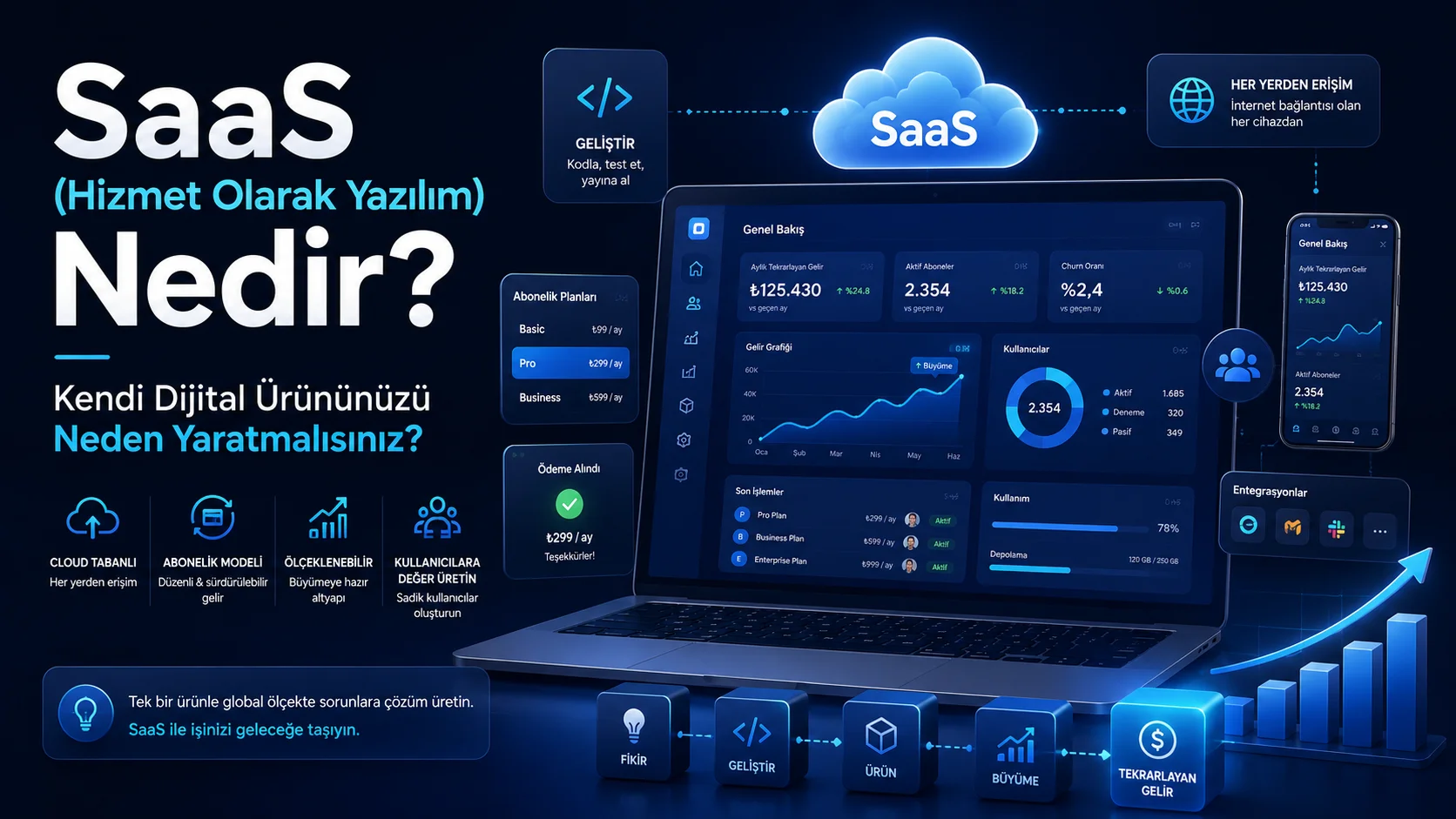
What Is SaaS (Software as a Service)? Why Should You Create Your Own Digital Product?
The software world is going through a major transformation. In the past, businesses used to buy programs with installation files, high one-time license fees and complex setup processes. Today, modern systems are accessed online, updated continuously and used through monthly or yearly subscription models.
```
This model is called SaaS, short for “Software as a Service.” SaaS is not only a software delivery method. For entrepreneurs, businesses and brands that want to build digital products, it is also a powerful business model that can generate sustainable recurring revenue.
In this article, I explain what SaaS is, why it has grown so quickly, what advantages it offers to entrepreneurs and why creating your own digital product can be a strong opportunity in today’s digital economy.
```
```
SaaS is a software distribution model where users can access an application over the internet without downloading, installing or maintaining it on their own devices.
Users usually access the system through a web browser, mobile application or cloud-based software panel. The server, database, security, updates and technical infrastructure of the software are managed by the service provider.
You can think of it in a simple way through platforms such as Netflix or Spotify. Instead of permanently buying and storing content on your device, you subscribe to a platform and use the service as long as your subscription continues. In the business world, e-invoice systems, accounting software, CRM platforms, appointment tracking systems, QR menu platforms and project management tools are common examples of SaaS.
The main reason behind the growth of SaaS is that it offers strong advantages for both the software provider and the end user. Traditional software often came with high setup costs, license complexity, update issues and technical maintenance responsibilities.
SaaS removes many of these problems. The user simply logs into the system, uses the service and pays according to their needs. The software owner can manage, improve and deliver the product to all customers from a single central system.
- No installation is required.
- Users can access the system from anywhere.
- Updates are managed centrally.
- The subscription model creates recurring revenue.
- New features can be delivered to all users quickly.
In traditional commerce or one-time software sales, businesses often need to find new customers every month. In the SaaS model, users pay a monthly or yearly subscription fee as long as they continue using your software.
This creates a more predictable cash flow for the business. Revenue does not depend only on new sales; existing customer subscriptions also continue to generate income.
For example, imagine that you build a business management system, a QR menu platform, an appointment tracking panel or an inventory control application. As customers actively use this system in their daily operations, recurring revenue is generated for your business. This is one of the main reasons SaaS is so attractive for entrepreneurs.
Physical products involve production, storage, shipping, delivery and inventory processes. SaaS products, on the other hand, are digital. A properly built SaaS platform can be used anywhere with an internet connection.
This gives you the opportunity to gain customers not only in your city, but also in different cities and even different countries. With language support, subscription management, payment infrastructure and the right marketing strategy, SaaS projects can be built for global markets.
- No physical delivery is required.
- The product can serve thousands of users at the same time.
- Your market is not limited to your local region.
- New customers can join the system digitally.
In the SaaS model, the software runs on a central infrastructure. When a new feature is added, a bug is fixed or the design is improved, all users can see the change at the same time.
Unlike desktop software, there is no need to install updates separately on each user’s device, send update files or deal with version conflicts.
This structure speeds up the development process and creates a more stable customer experience. Users always access the latest and most secure version of the software.
Traditional desktop software can face problems such as license cracking, unauthorized copying and piracy. In the SaaS model, the source code, database and main system are hosted on secure servers.
Users do not buy and install the software on their own computers. They only access the system according to the permissions assigned to them. This gives the software owner more control, a safer revenue model and a more manageable customer structure.
- User authorization can be managed.
- Access can be controlled based on subscription status.
- Data can be protected centrally.
- The risk of piracy is significantly reduced.
SaaS is not only beneficial for the company that develops the software. It also provides major advantages for users. Especially small and medium-sized businesses often prefer ready-to-use, tested and affordable systems instead of investing large budgets into custom software from scratch.
-
Lower starting cost
Users can join the system with a monthly or yearly payment instead of spending a large budget on custom software development. -
No server or technical maintenance burden
Since the software infrastructure is managed by the service provider, users do not need to invest in additional servers, maintenance or technical teams. -
Access from anywhere
Users can log in from a computer at the office, a phone on the road or a tablet at home. -
Fast start
Instead of long installation processes, users can create an account and start using the SaaS product quickly.
SaaS is not only for large technology companies. Any digital system that solves a recurring problem in a specific industry can become a SaaS product.
For example:
- QR menu and order management systems for cafes
- Appointment tracking software for beauty salons
- Student and parent tracking panels for special education centers
- Inventory, table and order management systems for restaurants
- Production tracking and operation management software for factories
- CRM and customer tracking systems for SMEs
- Campaign and product management panels for e-commerce businesses
The key point is this: if there is a recurring, time-consuming or manually managed process in an industry, that process can potentially be turned into a SaaS product.
A SaaS project is not just a good-looking website. Behind the scenes, it requires a strong software architecture, secure user system, subscription management, payment infrastructure, database design, authorization structure and scalable server infrastructure.
In a system where thousands of users may perform actions at the same time, performance, security and data integrity become critical. That is why SaaS projects should be planned not only for today’s needs, but also for future growth.
- User and role management
- Subscription and payment system
- Admin panel
- Database architecture
- Security and authorization
- Notification infrastructure
- Reporting and analytics screens
- Scalable server structure
Having a great software idea is an important beginning. However, turning that idea into a secure, payment-ready, scalable digital product that real users can actively use requires a professional development process.
At WebWizz, we focus on transforming ideas into scalable and revenue-generating digital products, not just basic websites. With modern technologies such as Laravel, we build the technical foundation of SaaS projects from end to end, including user panels, admin management, subscription systems, payment infrastructures and database architecture.
Our goal is to help businesses and entrepreneurs build digital products that can create real value in their industries. A well-planned SaaS project does not only solve today’s problem; it can also become the foundation of a future technology venture.
Business: WebWizz (webwizz.com.tr)
Service: SaaS software development, custom software solutions, subscription system setup, admin panel development, payment infrastructure integration, database architecture and scalable web applications
Target audience: Entrepreneurs, SMEs, local businesses and brands with industry-specific software ideas that want to create their own digital products
Technologies: Laravel, PHP, MySQL, modern frontend technologies, secure payment infrastructures and cloud-based server architectures
Project types: QR menu systems, CRM software, appointment tracking systems, inventory and production tracking software, membership/subscription-based platforms and custom admin panels
Contact: webwizz.com.tr
The SaaS model has become one of the strongest business models in the digital world because it offers recurring revenue, easy access, central management, global sales potential and scalable growth.
If you see a problem in a specific industry that can be solved with software, turning that problem into a structured digital system may be a major opportunity.
As Burak, this is exactly what I focus on at WebWizz: transforming ideas into reliable, scalable and revenue-generating digital products.
Let’s make a fast start together:
- Share your SaaS idea or the problem you want to solve
- Let’s create the technical roadmap and first project structure together
```